

AI Answering Service for Towing Companies (2026)
A tow call is different from almost every other call a small business gets. The caller is stuck, often on a shoulder or in a parking lot, sometimes at night, and they're working down a list of numbers. If yours goes to voicemail, they don't leave a message. They try the next one. That's why an AI answering service for towing companies is pitched so hard right now. The part the pitches skip is that a tow call needs things most AI receptionists can't do: an exact pickup location, a quick decision about whether a truck can go, and often a person on the line within minutes.
We make an AI receptionist, NoMissedCall, and it's one of the options below, so keep that in mind as you read. Every rival price here comes from that vendor's own page, checked on 6 November 2026. Two of the products in this article are built for towing and do things ours doesn't. We say where.
What a tow call needs that most calls don't
A plumber's AI receptionist can take a name, a number and a short description, and someone calls back within the hour. A tow call doesn't wait an hour. To dispatch a truck, someone needs:
- The exact location. An interstate and a rough exit isn't enough. You need the direction of travel, the nearest exit or mile marker, or a cross street. Many stranded callers don't know these, so the person answering has to ask the right questions.
- The vehicle and the problem. Make, model, two-wheel or all-wheel drive, whether it rolls, and whether it's a lockout, a jump start, a tire change or a full tow. That decides flatbed or wheel-lift, and whether the job is worth the trip.
- Safety. Whether the caller is in a travel lane, whether anyone is hurt, and whether police are already on scene.
- Payment and destination. Cash call or motor club, and where the car is going.
An AI can ask all of those questions. What it can't do on its own is decide which truck goes, give an honest arrival time, or reach a driver who is already hooking up another car. That gap decides which kind of product you need.
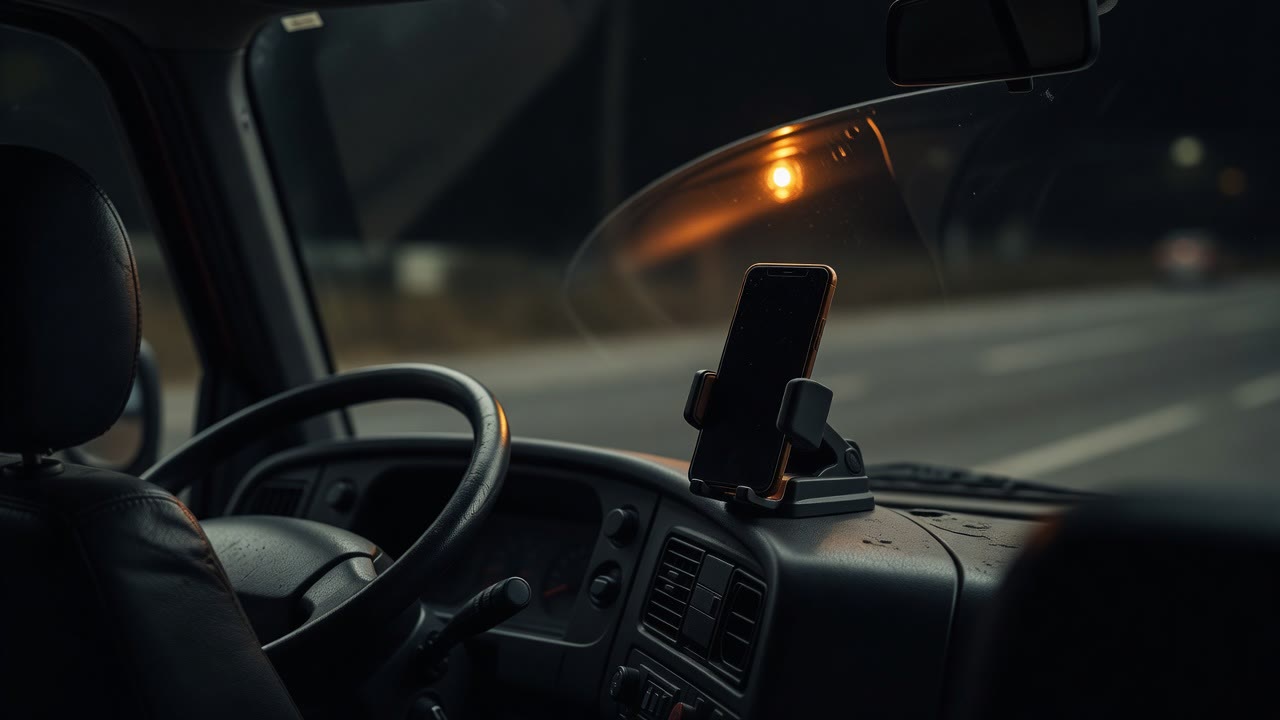
Why the driver can't just pick up
Most small tow operators answer the business line on their own cell phone. That works until the phone rings at the wrong moment. The two worst moments are behind the wheel and on the shoulder.
Behind the wheel, federal rules may forbid it. Under 49 CFR 392.82, "no driver shall use a hand-held mobile telephone while driving a CMV," and a motor carrier may not allow or require it. "Driving" includes sitting at a light or in traffic. It does not include a truck pulled off the road and stopped where it can safely stay. Whether your trucks count as commercial motor vehicles depends on weight and the kind of operation, as defined in 49 CFR 390.5. Most states also have their own hands-free laws for every driver. This is general information, not legal advice. Rules vary by state and change, so check with a lawyer about your own trucks and drivers.
On the shoulder, a phone is a distraction in a dangerous place. AAA reported in October 2025 that 46 emergency responders, including tow truck operators, were killed the previous year after being struck while helping others on the roadside, citing the Emergency Responder Safety Institute. Nobody should be writing down an address during a hook-up next to live traffic.
The honest case for an AI answering service for towing companies is narrower than "never miss a call." The call gets answered and the details get written down while the driver keeps both hands on the job, and the driver calls back once the truck is stopped somewhere safe.
How many tow calls go unanswered?
We looked for a towing-specific figure with a published method behind it and didn't find one. The nearest real number is Invoca's platform data for home services businesses, which puts unanswered calls at 27% (May 2024). CallRail reports 28% from its own customer data. Both companies sell call tracking, so treat these as vendor data.
You'll see much bigger numbers on towing AI pages. One towing vendor page we read today repeats a well-known missed-call percentage credited to a small-business study whose original page no longer exists. We traced that figure in our voicemail statistics audit and could not find the research behind it, so we don't repeat it. Your own phone bill is a better source. Count last month's missed calls on the business line, then count how many of those numbers called back.
Where tow work comes from changes what you need
Not every tow job starts with a call to your number. Motor club work increasingly arrives through the club's own software. Urgently, now part of Agero, describes on its product page a system that ranks providers on measures like "Time to Accept" and job cancellation rate. Agero says it helps more than 30,000 drivers a day. Those jobs come through an app or portal, so an AI on your phone line doesn't touch them.
That leaves the calls that do hit your number: private cash calls, lockouts, repeat customers, body shops and dealers, property managers, and people who found you on a map search. For a small operator, those are often the better-paying jobs, and they're the ones a phone AI can help with. If most of your volume is motor club dispatch, an AI receptionist will matter less to you than how fast you accept jobs in the club's app.
Your options for an AI answering service for towing companies
Towing-specific AI: NextPhone and AgentZap
Genuinely good: both are aimed at tow operators and both talk about Towbook, the dispatch software many small fleets use. NextPhone's Towbook page says its AI collects the pickup location, vehicle and type of service, then creates the tow call in your Towbook account while the caller is still on the line, and that this comes on the $299 Growth plan, set up by their team. NextPhone's pricing page lists Pro at $199 a month and Growth at $299, flat, with unlimited inbound calls and no per-minute charges, as of November 2026. A job that lands in your dispatch board without anyone retyping it is a real advantage. Nothing general-purpose, ours included, does that.
AgentZap's pricing page lists Starter at $109 a month for 150 minutes with $0.85 a minute after that, and Professional at $295 for 450 minutes at $0.75 a minute, as of November 2026. Both carry a $499 one-time training and setup fee, which the page says is waived on a 6-month term for Professional.
The trade-offs: AgentZap's towing page says Towbook, GPS and motor club integrations are "a custom build, quoted on your demo," so the $109 plan isn't the price of a Towbook-connected setup. Its page also carries the unsourced missed-call figure we mentioned above, plus large savings claims. NextPhone's Towbook link sits on the more expensive plan. Ask either one for a test number and call it from a noisy roadside before you sign.
Towbook itself is working on AI. Its beta site invites users to log in to meet "Towbi," described as an AI dispatch assistant, in early access. We couldn't see what it does without an account. If you already run Towbook, ask about it first.
General AI receptionists
Rosie is $49 a month for 250 minutes, $149 for 1,000 and $299 for 2,000, as of November 2026. Its $149 Scale plan lists warm transfers, live call transfers and texts to callers during the call. For towing, live transfer matters. It lets the AI pass a real emergency to your on-call driver instead of just taking a message. Rosie beats us on that.
Clara (heyitsclara.com, from 44pixels Ltd, not the unrelated getclaraai.com) is $39.99 a month or $69.99 for Pro, with unlimited calls on every plan, as of November 2026. A busy storm night costs the same as a quiet week, and no minute-based product can match that.
Smith.ai's AI receptionist is free for 25 calls a month and then $3.00 a call, or $150 a month on Pro at $2.00 a call, as of November 2026. Per-call pricing suits a low-volume operator who only wants overnight coverage.
RingCentral's AI Receptionist starts at $49 a month for 100 minutes, with $0.50 a minute after that, as of November 2026. It makes the most sense if your office phones already run on RingCentral.
Human answering services
A human service is still the right call for some tow operators, especially anyone doing police rotation or heavy-duty recovery, where a misheard detail is expensive. PATLive lists $189 a month for 100 minutes, which it describes as about 40 calls, and $349 for 200 minutes, as of November 2026. A trained person can judge whether a caller sounds unsafe, and a script can't do that as well. You pay several times more per call. Our cost comparison works through the numbers.
| Option | Published price (as of November 2026) | Live transfer to a driver | Dispatch software link |
|---|---|---|---|
| NextPhone | $199 Pro, $299 Growth, unlimited inbound calls | Ask on demo | Towbook, on Growth |
| AgentZap | $109 for 150 minutes, plus $499 setup | Ask on demo | Custom build, quoted |
| Rosie | $49 for 250 minutes; $149 for 1,000 | Yes, on Scale | None published |
| Clara | $39.99, unlimited calls | Not checked | None published |
| Smith.ai AI | Free for 25 calls, then $3.00 a call | Not checked | None published |
| PATLive (human) | $189 for 100 minutes | Not checked | None published |
| NoMissedCall | 250 or 500 minutes, billed in the app stores | No | Webhooks only |
Where NoMissedCall fits, and where it doesn't
NoMissedCall is an app. It answers your business line, asks the questions you set, and puts the transcript, summary and recording on your phone with a push notification when the call ends. The regular plan includes 250 AI minutes a month and Premium includes 500, billed through the App Store and Google Play.
Its best feature for towing is ring-first. Your phone rings first and you press 1 to take the call. If you don't answer, because you're driving or working a hook-up, the AI picks up. Calls you take yourself don't use AI minutes. The Help Center explains ring-first and carrier forwarding.
Here is where it falls short for a tow company:
- No live transfer. Once the AI has the call, it can't hand the caller to your on-call driver. It takes the details and you call back. Rosie's Scale plan and a human service do better here.
- No dispatch software link. It doesn't write jobs into Towbook. Premium can send call data to other tools through webhooks, but that's a project, not a switch. NextPhone does this out of the box.
- Minute caps are hard. When the minutes run out, the AI pauses until your billing date, while ring-first keeps ringing your phone. Clara's unlimited calls and NextPhone's flat pricing are easier on a winter storm month.
- Spam filtering is Premium only. Robocalls on the regular plan use minutes. Our spam call guide covers what else you can do.
It suits a one- or two-truck operator who carries the business line on a cell phone, wants to stay first in line for every call, and needs the AI as a safety net for the calls they can't safely take. A fleet with a dispatcher and Towbook should look at NextPhone or Towbi first.

How to set up any AI on a tow line
- Write the location script first. Tell the AI to ask for the road, the direction of travel, the nearest exit, mile marker or cross street, and a nearby landmark, then read it back. A wrong location costs more than a missed call.
- Put safety first in the instructions. If the caller is in a travel lane or anyone is hurt, the AI should tell them to call 911 before anything else.
- Don't let it promise an arrival time. Have it say someone will call back within a set number of minutes, then make sure someone does.
- Decide the price rule. Give fixed prices only for simple jobs like lockouts and jump starts, or give none. A phone quote that changes at the scene is a quick way to get a complaint.
- Start with missed calls only. Use conditional forwarding so the AI only gets the calls you don't answer, as covered in our call forwarding guide.
- Test it from the road. Call from a noisy place, give a vague location, and ask for a price. Read every transcript.
For the wider category, see our home services overview, the auto repair shop guide, and our notes on AI disclosure rules before you switch any AI voice on.
Test any AI answering service for towing companies with one call: say you're broken down near an exit, in the dark, and you don't know the mile marker. If it gets a location your driver can find and tells you plainly when someone will call, it's worth the money. If it can't, keep looking, whatever the price.
Frequently asked questions
What is the best AI answering service for towing companies?
It depends on how you dispatch. If you run Towbook, NextPhone's Growth plan creates the tow call in Towbook during the call, and Towbook is testing its own AI assistant, Towbi. If you want a live handoff to your driver, Rosie's Scale plan lists live call transfers. A one-truck operator who answers on a cell phone can use a general AI receptionist as a backup for missed calls.
How much does an AI answering service for towing companies cost?
Published prices as of November 2026: Clara $39.99 a month with unlimited calls, Rosie $49 for 250 minutes, AgentZap $109 for 150 minutes plus a $499 setup fee, NextPhone $199 a month flat and $299 with its Towbook link. A human service such as PATLive starts at $189 for 100 minutes.
Can an AI receptionist dispatch a tow truck?
Not on its own. It can collect the location, vehicle, problem and payment type, and some products write that job into dispatch software. A person still decides which truck goes and when, and calls the customer back with a real arrival time.
Can my tow drivers answer calls while driving?
Federal rule 49 CFR 392.82 bars hand-held phone use while driving a commercial motor vehicle, and most states have hands-free laws. Whether your trucks are covered depends on their weight and operation. This is general information, not legal advice, so check with a lawyer.
Does NoMissedCall integrate with Towbook?
No. NoMissedCall has no Towbook integration and cannot transfer a live call to a driver. It saves a transcript, summary and recording of each call in the app, sends a push notification, and on Premium can send call data to other tools through webhooks.
Try it on your own phone
No Missed Call is an AI receptionist that answers your business line 24/7, books appointments straight into your calendar, and sends you a transcript and summary of every call. Setup takes minutes from your phone, and there is a 7-day free trial.
Download on the App Store · Get it on Google Play · Read the Help Center
